All Cotswolds Destinations
Browse our complete collection of group cottage locations. Each destination offers unique experiences and carefully selected properties perfect for group holidays.



No places match that search. Browse all cottages instead.
Discover amazing group cottage destinations across the Cotswolds. From honey-stone villages to rolling countryside escapes, find your perfect group getaway location in this Area of Outstanding Natural Beauty.
Browse our complete collection of group cottage locations. Each destination offers unique experiences and carefully selected properties perfect for group holidays.
No places match that search. Browse all cottages instead.
The Cotswolds covers nearly 800 square miles of honey-coloured stone villages, wool towns and open wold, spread over several counties. It's the largest National Landscape in England. A house near Bourton-on-the-Water and a house outside Cirencester can be 45 minutes apart on narrow lanes, so where you stay shapes the whole break.
Start with what your party wants to do most.
The location pages above list our group cottages in the Cotswolds town by town, with the large houses in each place first and others within about 15 miles below. Here's what each area is like for a big group, from the busy honeypot villages in the north to the quieter valleys in the south, with the practical details that matter when twelve or twenty people are sharing one house.
Prefer to search by size? Browse all our large holiday houses, or go straight to cottages sleeping 8 or more, 10 or more or 12 or more. Every card shows how many each house sleeps.

This is the classic picture-postcard Cotswolds. The villages are close together, so you can walk from one to the next for lunch and be back at the house by dark.
Bourton-on-the-Water has the River Windrush running through the middle under a row of low stone bridges. Children paddle. There's a model village of Bourton itself and Birdland, a bird park on the edge of the village. It gets very busy on summer weekends, so a house a mile or two out is often a better base.
The Slaughters are two tiny villages on the River Eye, linked by a flat footpath across the fields. The walk from Bourton to the Old Mill at Lower Slaughter and on to Upper Slaughter takes about an hour each way.
Stow-on-the-Wold sits on a hilltop at around 800 feet, the highest town in the Cotswolds. Its big market square is lined with antique shops, tea rooms and old coaching inns. Stow is central, so most of the north Cotswolds is within 20 minutes.
Moreton-in-Marsh has a large Tuesday market and, usefully for groups, a railway station with direct trains to London Paddington. Batsford Arboretum is just outside the town. If some of your party are coming by train, a house near Moreton saves a lot of lifts.
At the northern edge, the hills drop sharply to the Vale of Evesham, and the views are some of the best in the area.
Chipping Campden is a wool town with a long curved high street and a 17th-century open-sided Market Hall. It's the northern start of the Cotswold Way, a 102-mile National Trail that runs to Bath. Walking groups can do a short stretch to Dover's Hill for views across the vale. Hidcote, the National Trust garden, is four miles away.
Broadway, just over the Worcestershire border, has a wide green and a high street of galleries and cafés. Broadway Tower, a folly on the hill above, can be seen from miles around. On a clear day you can see several counties from the top.

The south is quieter. Houses here are often larger, and the drive from Bristol, Bath or the M4 is short.
Bibury is home to Arlington Row, a line of 14th-century weavers' cottages that William Morris called the most beautiful village in England. It's small. Go early, because by mid-morning the coaches have arrived, the bridge is crowded with people taking the same photograph, and the narrow lane past the cottages is hard to walk along.
Castle Combe, in Wiltshire, is a single wooded valley street of stone cottages with no modern buildings in sight. It has been used as a location in films such as War Horse and Stardust.
Cirencester was Corinium, the second-largest town in Roman Britain. The Corinium Museum tells the story, and the remains of the Roman amphitheatre are free to visit. Cirencester Park, on the edge of town, is open for walks.
Stonehouse sits in the Stroud valleys on the western edge of the Cotswolds. It's a handy base for Slimbridge Wetland Centre, Westonbirt Arboretum and Gloucester, with the M5 close by.
Burford is known as the gateway to the Cotswolds from Oxford. Its high street runs steeply down to a medieval bridge over the Windrush. The Cotswold Wildlife Park, a few minutes south, has rhinos, giraffes and a narrow-gauge railway. It's an easy day out with children of mixed ages.
Cheltenham is a Regency spa town with the area's biggest choice of restaurants and shops. The Cheltenham Festival in March is the highlight of the jump-racing year, and big houses nearby are booked far ahead for festival week. The town also hosts well-known jazz, science and literature festivals.
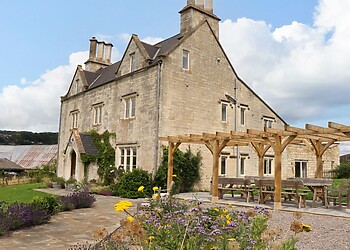
Group accommodation in the Cotswolds comes in a few distinct types. Old stone manor houses and farmhouses have the space and the big kitchens, but bedrooms can be up steep stairs. Converted barns tend to have one huge open-plan room, which is great for friends who want to cook and eat together. Clusters of cottages on one estate let families keep their own front door while sharing a pool, games room or garden.
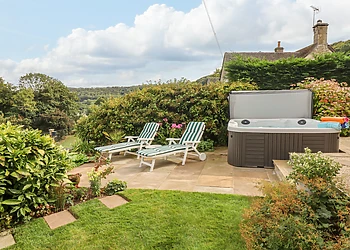
For a special occasion, look for a hot tub, a games room or a dining room that seats everyone. If you're bringing a dog, filter for pet-friendly houses. Some luxury houses sleep 20 or more, but they're rare and book up years ahead for New Year.
Walkers want boot rooms and a village pub. Families with small children want a safe garden and ground-floor space. A party of friends wants somewhere to relax after dark without disturbing the neighbours.
| Area | Best for | Good to know |
|---|---|---|
| Bourton and the Slaughters | Families, first visits, village walks | Very busy on summer weekends |
| Stow and Moreton | Touring the whole area | Train station at Moreton |
| Chipping Campden and Broadway | Walking groups, views | Start of the Cotswold Way |
| Bibury and Cirencester | Quieter breaks, Roman history | Short drive from the M4 and M5 |
| Burford | Groups coming from Oxford and London | Cotswold Wildlife Park close by |
| Cheltenham | Race weekends, celebrations, nights out | Book festival week a year ahead |

Big birthdays, anniversaries and family reunions are the most common reason people book a large house here. A shared house gives you one kitchen, one long dining table and private space for everyone, which a hotel can't match.
Some practical points make the weekend run smoothly:
Late spring and early autumn are the sweet spots: the gardens are at their best, and villages like Bibury and Bourton are calmer than in August. Summer weekends and school holidays fill up fast, especially for houses sleeping 16 or more. December brings Christmas markets and fireside weekends, and big houses often book up for New Year a year ahead.
The M5 runs along the west side of the Cotswolds and the M40 and M4 sit to the east and south. Trains on the Cotswold Line stop at Moreton-in-Marsh, Kingham and Charlbury, and there are mainline stations at Cheltenham Spa and Kemble. You'll still need cars. A long weekend works well from London, Birmingham or Bristol, as each is around two hours away or less.